Category Archives: Developing

The natural path of the development of the Moon

Why Lunar Tourism Will Never Be Practical.

The practicality of lunar tourism is a function not just of consumer interest, but by the physical realities of the mission.  These include orbital mechanics, energy requirements and mission duration.  The orbital transfer used, for reasons of safety,  would be the same as used in Apollo, the Hohmann orbital transfer, and from that energy and fuel requirements may be calculated.  The Moon and the launch site on Earth (or the position of a Space Station, if it was from that that departure for the Moon occurred) would need to be in precise alignment.

The location on the Moon for the landing would most likely have to be in lunar “dawn” or “Morning”, Continue reading Why Lunar Tourism Will Never Be Practical.

Rovers Using IFR Navigation on the Moon?

Pilots navigate aircraft in two separate ways, abbreviated IFR and VFR. IFR is a term pilots use for “Instrument flight rules”, as opposed to “visual flight rules.” Visual is when a pilot flies by using his eyes to reference terrain, and uses his instruments as a secondary reference. They are necessary – for example, a pilot cannot tell with any precision his height above the ground without looking at the altimeter.

But with Instrument Flight Rules the pilot only uses his instruments. Ocean vessels are also captained when necessary in weather conditions by IFR methods.

In the book, it’s proposed that given the existing databases of lunar terrain, accurate down to a half meter for most of the Moon, IFR navigation of rovers on the lunar surface is plausible.  Continue reading Rovers Using IFR Navigation on the Moon?

Lava tubes on the Moon

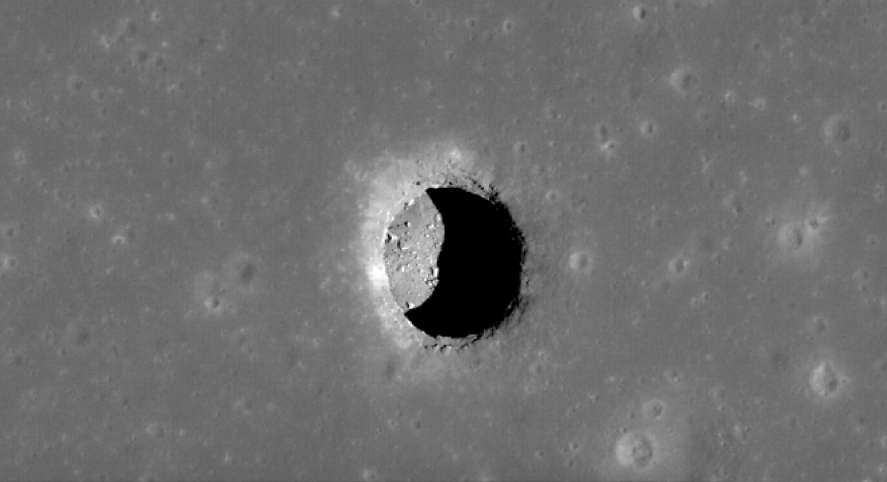
Lava tubes are natural formations which follow volcanic activity. A stream of lava flows down an incline, the outside freezes while the interior continues flowing, until the interior is an empty tube. These tubes exist on Earth, and on the Moon and Mars.

On the Moon, these tubes are usually located near the boundaries of highland areas with Mares. Various popular articles have touted the possibility that future lunar settlements could house the habitats inside lava tubes. Tubes larger than 1000 feet in cross section may exist, buried under a hundred meters of hard rock. Continue reading Lava tubes on the Moon

Is selling a one way trip to Mars a scam?

At this time (2015) they are a scam. The development of technology and solutions for such travel is not, but the selling of trips is, because it presupposes the existence of such technology and solutions. And they do not exist.

When would such a thing not be a scam?

When when facilities existed on the Red Planet to house and shelter humans and provide for their basic needs. When rockets existed in the size and style required for transport.

Therefore, the business opportunity in 2015 would seem to be in those infrastructure developments.   Those would be nanotech fabricators, various forms of 3d printers and replicators, and robots.  If these are not to the required technological level to accomplish the jobs as defined on Mars, then the useful work would be in bringing them to that stage.

This is all particularly true given that Mars has the full complement of elements to produce plastics, composites, and ceramics, as well as metals and metal alloys.

The Moon is Lacking the Ingredients of Life

The Moon is lacking the basic ingredients of life, therefore it will never be a world with life.

For any manned colony in space, the elements of oxygen, carbon and nitrogen are essential to life.  These elements are common on Mars.  This directly means Mars is a plausible site for manned colonies.  It is also why the Moon is Continue reading The Moon is Lacking the Ingredients of Life

Is a manned return to the Moon practical?

Although anything can be done, and several nations would like to match the American accomplishment of landing men on the Moon, the greater question is “Why?”

The American accomplishment of the Apollo missions simply cannot be matched. Repeating something done in 1969 with a flight in 2019, fifty years later is not matching Apollo.   It is repeating it, with all the advantages of advanced technology.   Fifty years worth.  It is like doing a cattle drive of the 1870s, in 2015. Continue reading Is a manned return to the Moon practical?

Light and shadow on the Moon

This is a brief look at  the issues of Lunar light and shadow.

First, consider that the limit of either light or shadow is the horizon, which is much closer on the Moon than on Earth.  On flat terrain such as a Mare, consider the horizon as less than two kilometers distance.  A 500 meter peak may cast a shadow over forty kilometers distant – far “over the horizon.”

Effectively this is why the lunar North and South pole could not be imaged until LRO did it with radar.  Consider the solar terminator moving the line of sunlight and dark across the lunar surface.  The Moon has a slight axial tilt relative to the Sun, so the point we call the “North Pole” is not 90 degrees tangent to the Sun.

Because of the lack of an atmosphere, the transition from light to dark is sudden, abrupt and total.  Continue reading Light and shadow on the Moon

Lunar Timekeeping.

Rover operators attempting to maximize productivity on the Moon would benefit from a calendar and a timekeeping system specific to the requirements on that world. This is a very different thing than the use of a Lunar calendar on Earth.   On Earth, calendars help in predicting seasons, tides, eclipses and other phenomena of interest on Earth.

What is of interest for Lunar operations  as far as a time system?  Continue reading Lunar Timekeeping.

Lunar Helium 3: Where is it? Can it be mined?

Helium 3 is found exclusively in the lunar regolith, where it is implanted by the solar wind.  This means that the molecules head for the moon from the sun at high velocity, hit the dirt and embed themselves directly into a solid object on the surface.  Typically this is what we would consider a dust particle.  The smaller particles, less than 50 nm in size will show the highest concentration due to their surface to volume ratios.  It is reported that mechanical agitation of the soil can release the he3 quite easily.

The method of recovery of he3 on the moon as proposed Continue reading Lunar Helium 3: Where is it? Can it be mined?

How could Lunar Polar ice be mined?

This  is a surprisingly difficult problem.

The general idea is to not add heat to the environment where it’s so cold that the moon has saved up ice for us over billions of years.  Add heat, and the goodies evaporate.  Industrial scale engines and machines which create lots of waste heat may be out. In turn that means that a self contained rover might be a problem.  What mechanical machine could we make that would work at 80 kelvin? Continue reading How could Lunar Polar ice be mined?

Lunar Ecology – Or Not

Ecology is defined as “The branch of biology that deals with the relations of organisms to one another and to their physical surroundings.”   One part of the MotM plot is Eli’s commitment to maintaining the Moon in a pure and untouched condition.  Like many others, he misunderstands what this means.

Preservation of useful attributes of the Moon for future generations has to be figured from first principles.  What are they?

The primary attribute of the Moon which could be damaged by industrialization is Continue reading Lunar Ecology – Or Not

Where might lunar helium 3 deposits be best?

Helium 3 is found exclusively in the lunar regolith, where it is implanted by the solar wind.  Many scientific proposals and papers on lunar resource mining and extraction are completely impractical.  They represent attempts at adaptation of methods used on Earth.  On Earth, chemicals such as fluoride or cyanide may be used in aqueous solutions Continue reading Where might lunar helium 3 deposits be best?