The jury is still out on whether space based or Moon based telescopes are superior, and for what purposes.
Telescopes may be either single tube, or an array. They may study the visible light spectrum, an extended version of it, or the radio frequencies. And they may be Earth based, space based or Moon based. To a first approximation, the resolution of an array of telescopes is based on the furthest distance between the individual scopes in the array.
Pilots navigate aircraft in two separate ways, abbreviated IFR and VFR. IFR is a term pilots use for “Instrument flight rules”, as opposed to “visual flight rules.” Visual is when a pilot flies by using his eyes to reference terrain, and uses his instruments as a secondary reference. They are necessary – for example, a pilot cannot tell with any precision his height above the ground without looking at the altimeter.
But with Instrument Flight Rules the pilot only uses his instruments. Ocean vessels are also captained when necessary in weather conditions by IFR methods.
In the book, it’s proposed that given the existing databases of lunar terrain, accurate down to a half meter for most of the Moon, IFR navigation of rovers on the lunar surface is plausible. Continue reading Rovers Using IFR Navigation on the Moon?→
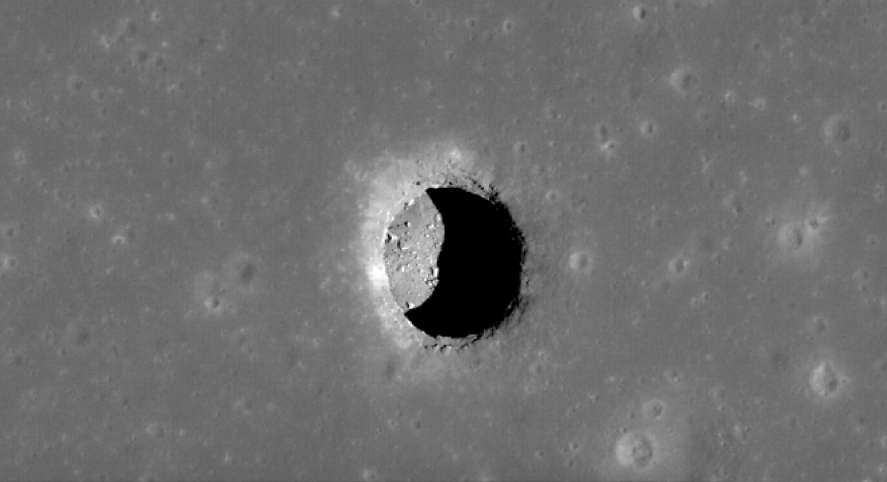
Lava tubes are natural formations which follow volcanic activity. A stream of lava flows down an incline, the outside freezes while the interior continues flowing, until the interior is an empty tube. These tubes exist on Earth, and on the Moon and Mars.
On the Moon, these tubes are usually located near the boundaries of highland areas with Mares. Various popular articles have touted the possibility that future lunar settlements could house the habitats inside lava tubes. Tubes larger than 1000 feet in cross section may exist, buried under a hundred meters of hard rock. Continue reading Lava tubes on the Moon→
Because everything on the Moon is white, grey, or black, there is often no sense of perspective. Is there an easy way to tell when a slope goes down or up? If you see a group of mounds, are you sure they are not craters? How does one tell a sinuous rille, which goes down like a riverbed, from a lava tube, which rises above the ground?
In the picture you can see a box or “Fortress,”, possibly built by ancient aliens. Why has NASA hidden this from us? How long have they known about it? What else have they hidden?
Answer.
It’s just one more dull, uninteresting pile of basaltic rock with a layer of moon dirt and dust piled on top. Nobody has hidden anything. It just happens to be shaped crudely similar to a box, therefore some people may choose to build a myth on top of this natural formation. Then they try to fool others into a NASA Conspiracy hoax.
Although anything can be done, and several nations would like to match the American accomplishment of landing men on the Moon, the greater question is “Why?”
The American accomplishment of the Apollo missions simply cannot be matched. Repeating something done in 1969 with a flight in 2019, fifty years later is not matching Apollo. It is repeating it, with all the advantages of advanced technology. Fifty years worth. It is like doing a cattle drive of the 1870s, in 2015. Continue reading Is a manned return to the Moon practical?→
By “native engines” we refer to engines made strictly from Lunar materials. These are engines that produce mechanical motion. Native production of rocket motor propellants, and of rocket motors will be handled separately.
Radar is used. Single polarity beams are focused on specific areas, then the returns are examined. The more mixed polarities in the returns (CPR) the rougher the area is.
In this post I use the typical person’s definition of “alien”, some bug eyed thing with oversized brains and flying saucers, giant spaceships, whatever, and likely with two legs. There are other and more logical or likely constructs, but we’ll stick to the typical fantasy creation.
We would have the ability to know, but first we would have to look.
You may have heard that scientists have discovered ice on the moon. Here’s what is going on. Any molecules of water, oxygen, or any other thing floating around the moon perform ballistic orbits. A molecule might bounce a dozen times before settling down or flying on out of the gravity well. BUT if it randomly goes by the north or south pole, it slows down, because it’s cold there. At the poles, the Sun is low on the horizon, and solar irradiation is long slant rays. But the Moon is covered with craters! This means that there are places sunlight never reaches. Continue reading Lunar Poles – Coldest Places in Solar System→
The viewer enables zooming in to 1.5′ resolution, and allows panning and exploring the crater.
This crater is about 26W, 46N, and it is of interest for a simple reason: There have been many recent and historical reports of odd phenomena in the general vicinity of the crater–blue glow, darkening and red, unusually bright appearance, as examples.