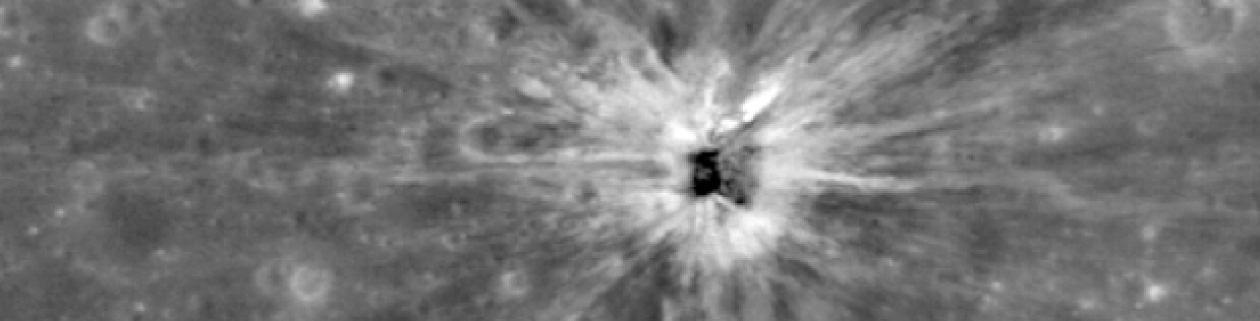

Because everything on the Moon is white, grey, or black, there is often no sense of perspective. Is there an easy way to tell when a slope goes down or up? If you see a group of mounds, are you sure they are not craters? How does one tell a sinuous rille, which goes down like a riverbed, from a lava tube, which rises above the ground?
As an example we’ll use the the area of Lunar Polar Base, illustrated above. First you see numerous perfectly round objects, with part of the interior darked. To prove these are craters and not mounds, first note that mounds are almost always gradual slopes, while craters can have steep sides.
Note the side of the crater which is sunlit and try to find others similarly sunlit, then look for something which has the reverse.
 Many times the sun angle will make it hard to see depth. In the above section, basically all the surface features including the long worm like artifacts go down into the ground.
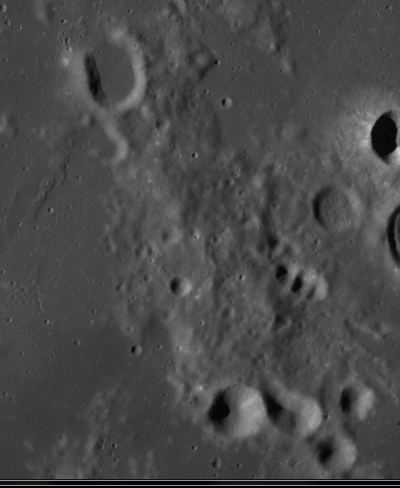 Here, establishing that craters have light on their right interior, gives us the perspective required to understand that the flatland to the left rises into hilly terrain toward the right. This picture shows craters of widely ranging ages plus two multiple impact zones, possibly where a single meteor broke up under gravitational accelerative stresses while inbound into the Moon’s gravity well.
In summary, to view the Moon find objects that clearly go up or down, and for the given sun position shadows cast are clear. Other objects will show the same shadow pattern.