

This is an interesting subject that I found while looking for surface anomalies that could provide a basis for a plot or scene – the crash sites of the Saturn boosters. The LRO found the Apollo fourth stages. And they are not normal craters.
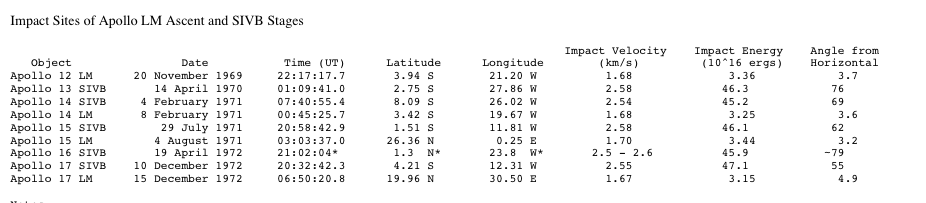
From http://nssdc.gsfc.nasa.gov/planetary/lunar/apollo_tables.html, we have this data, regarding the impact speeds, angles and energy.
Here’s what the booster looked like.

Here’s what it looked like after it impacted.
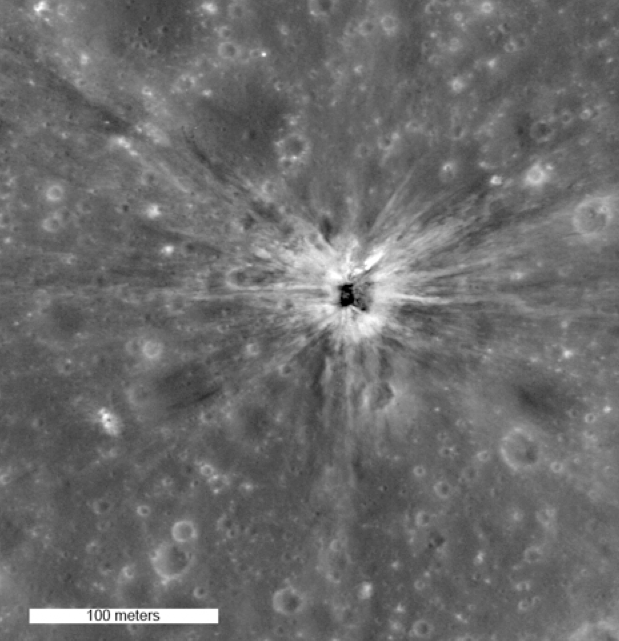
Note the black hourglass shaped object in the center. This is not a typical impact crater. Typically, a crater shows molten, vaporized, and aggregate ejected. Typically impact occurs at a speed in excess of 50,000 miles per hour. Also, the black is too black, indicating a deep pit or a very radar absorbent surface. (When I have more time I will see if there are LRO images for the Saturn sites from various sun angles, including close to high noon local. That would tell us about the depth. But also, the LRO data-sets themselves provide three dimensional resolution. The Saturn booster craters should be ten or twenty pixels in each dimension, probably enough resolution to provide depth data.
With the Saturn booster, the the impact velocity was just over 5,000 miles per hour, resulting in an object weighing about 10 tons having an impact with the force of about equal to 10 tons of TNT.
Depending on the orientation of the booster at the time of impact, the time from first touch to the farthest section of the structure impacting would have been two to five milliseconds. Aluminum is ductile, under pressure it will flow like a liquid. The force of impact was sufficient to melt all the aluminum, but not sufficient to vaporize any of it. It is reasonable to think that the Al of the booster initially became small droplets, and now exists as the frozen of those droplets. A powder.
By examination, obviously there were not sufficient energies to form a perfect crater, yet that is what explosions do. But here we must remember that the dynamics are different on Earth, where the atmosphere itself carries the force of an explosion. There being no atmosphere on the Moon, the force is carried only by the aggregate ejected from the impact. Unless to some degree, the impact separated some of the oxygen in the soil, or the booster contained a reserve fraction of oxygen and/or hydrogen, which then may have served as a small local atmosphere.
There are a number of questions about the after effects of an impact below the energy levels that would immediately vaporize the object impacting.
- Is the surface rich in salvageable Aluminum?
- Was enough energy on impact sufficient to heat the soil, releasing oxygen which then combined with the metals?
- Are the metals in the crater, or in the area surrounding by way of ejected mass?
Finally, note from the table that many impacts, those for which braking had been done to achieve lunar orbital insertion, were at impact energy levels far lower – like 1/15 the energy. These tended to be low angles to the lunar surface, thus the remains should be scattered over a wide area, unless something like a mountain ridge was in the way.
However, those were smaller and lighter spacecraft. By contrast, the Saturn stage, at some ten tons weight each, might plausibly represent a cache of ready to use aluminum, a significant fraction of which could be salvaged. The economic viability of this would have to be weighed against alternatives, such as simply extracting and purifying aluminum from the lunar dirt.
But, if a few tons of retrievable fairly pure aluminum was right on the surface, it could be used to surface coat mirrors. Then there would be practical considerations of moving the aluminum to the location where the mirrors were to be fabricated.
Here is the LRO image strip containing the Apollo 14 booster imact. You can roam around in it and compare the booster impact site with typical crater formations.
http://wms.lroc.asu.edu/lroc_browse/view/M107049825RE
Against everyone’s advice, Klondike had set off three Lunar days earlier toward the Saturn impact site, pulling a simple trailer. The Klondike rover would be returning within an hour, pulling a trailer full of pure aluminum, some fifty kilograms of it. Rumor was that coating a solar power mirror with pure aluminum would give it three times the effectiveness of the simple melted sand they were using for the surface currently.
But would the Klondikers even sell? And if so, at what price?